Engineering work with public source code. Every project states what was built, the evidence behind it, and its real status — prototypes are labelled as prototypes. The gold bar marks an artifact you can open and use today.
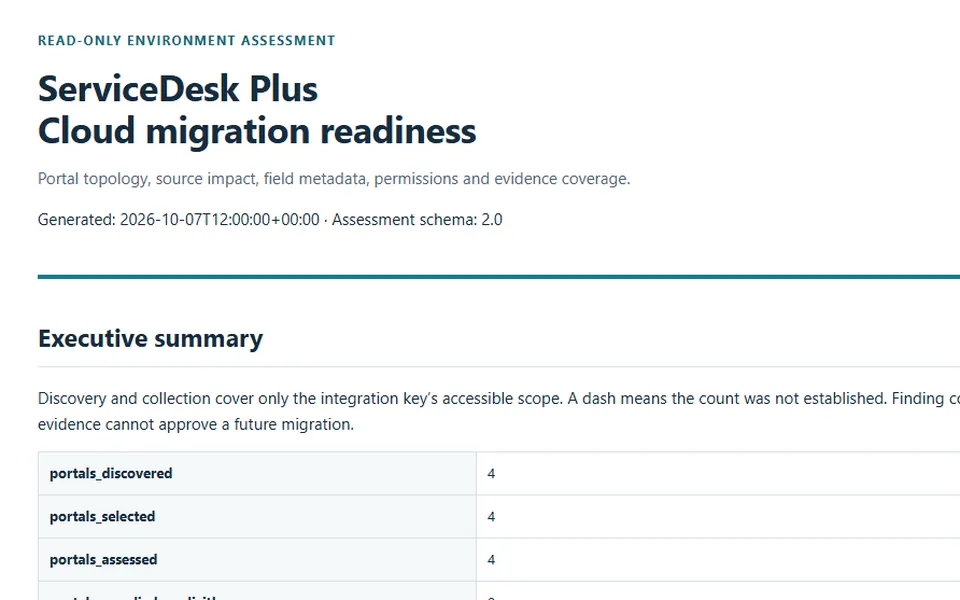
A local, read-only assessment of ManageEngine ServiceDesk Plus on-premises before migration to Cloud. Discovers portals, collects inventory and metadata through reviewed API reads, and records coverage gaps instead of guessing.
Python
REST API
ServiceDesk Plus
Windows
Problem, architecture & evidence
Problem
Teams planning a move to ServiceDesk Plus Cloud rarely have an accurate inventory of what their on-premises portals actually contain, configure and depend on.
Architecture
Operator promptURL and API key; keys never saved
Portal discoveryOne key, per-instance keys or credential file
Read-only collectionReviewed HTTP GET operations only
AnalysisConfiguration findings and coverage gaps
Offline reportsHTML, JSON, CSV and Markdown
Implemented
Multi-portal discovery with single-key, per-instance or credential-file routing.
Collection restricted to reviewed HTTP GET operations; keys never accepted as CLI arguments or saved in reports.
Offline HTML, JSON, CSV and Markdown reports with explicit coverage gaps.
Python 3.10+ standard library only; Windows launchers and a portable .pyz release build.
Verification
Unit and integration tests with synthetic fixtures; committed synthetic and recovery assessment examples; an offline --demo mode that needs no credentials or network.
Status & limits. Independent assessment tool — not a ManageEngine product or an automated migration engine. An assessment is not migration approval or proof of complete source visibility.
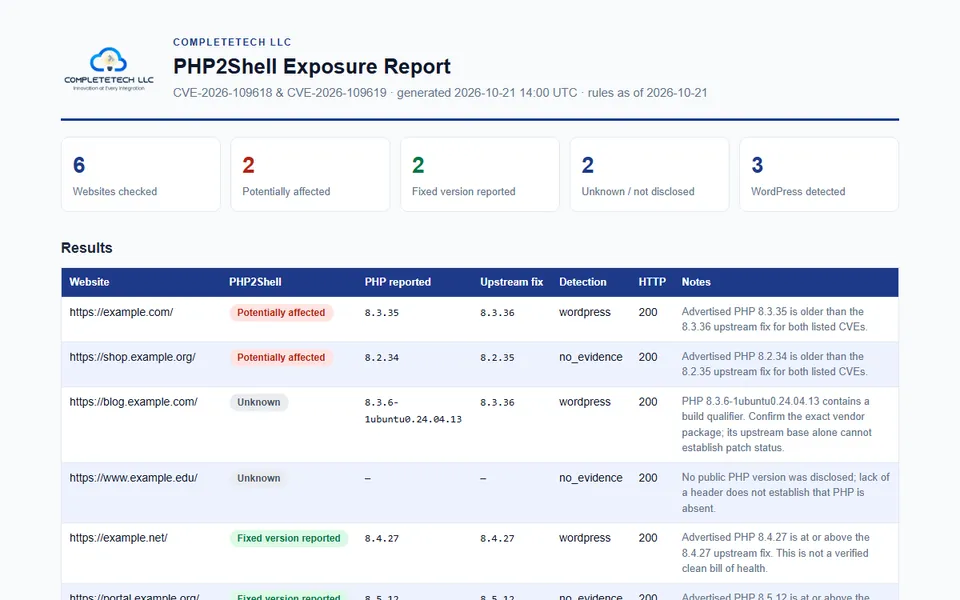
Passive checker for CVE-2026-109618 and CVE-2026-109619. Reads the PHP version a website already advertises and compares it with the official upstream fix for each PHP branch, then produces branded CSV, JSON or HTML reports.
Python
HTTP
CVE analysis
HTML reports
Problem, architecture & evidence
Problem
After a PHP security advisory, site owners need a fast, non-intrusive way to see which of their websites advertise an affected version.
One ordinary GET per page after checking robots.txt; no exploit payloads or crafted requests.
Version comparison against documented fixes for PHP 8.2–8.5.
Single offline HTML report with summary tiles, light/dark theme and custom branding.
Single-file Python with zero third-party runtime dependencies; bundled agent skill.
Verification
Local-only unit test suite in CI (no external websites contacted); thresholds checked against the PHP project advisories on 2026-10-21; synthetic sample report from reserved example.* domains.
Status & limits. Passive exposure indicator, not exploitation verification. Hidden or vendor-patched versions are reported as unknown, never as safe.
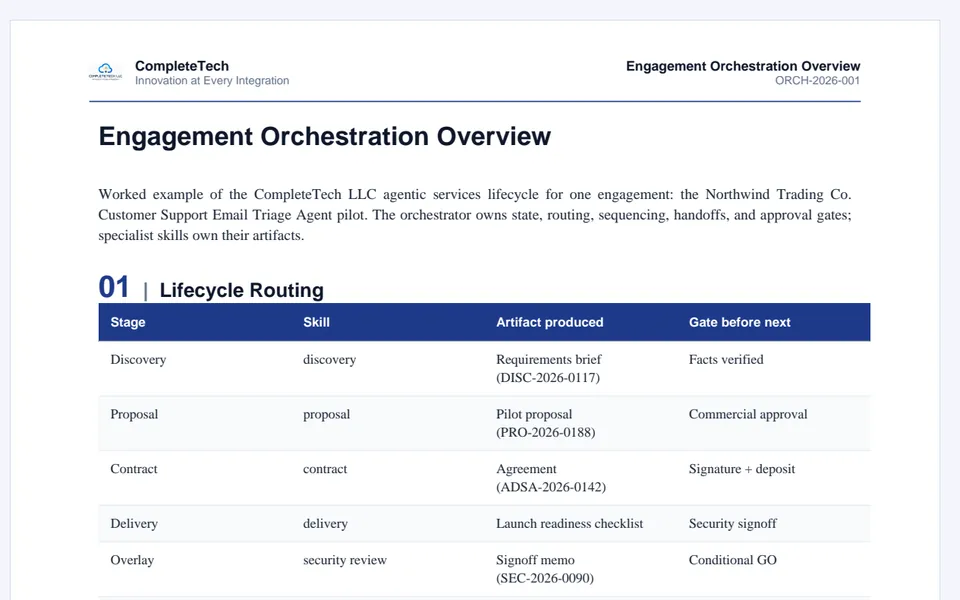
A library of seven reusable AI agent skills covering the services lifecycle — discovery, proposal, contract, invoice, delivery and customer success — coordinated by a schema-driven orchestrator with explicit approval gates.
Python
Agent skills
YAML schemas
ReportLab
Problem, architecture & evidence
Problem
Agents can draft business documents quickly, but commercial, legal and billing decisions must stay with the people who own them.
Architecture
Request or changeArtifact, client change or new work
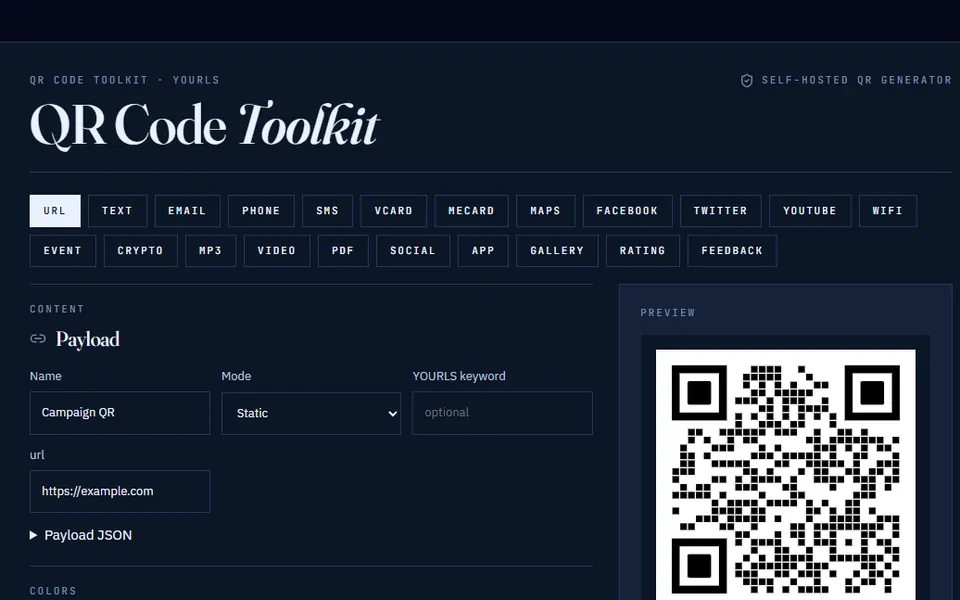
Customer studio for personalised ticket-stub keepsakes: paste an event link, watch facts get researched while the stub prints, then edit, approve and export. The composition root for a multi-repository hackathon system.
Next.js
TypeScript
SQLite
LLM agents
Stripe
Problem, architecture & evidence
Problem
Turning a single event link into a researched, personalised printed keepsake needs research, creative generation, approval, payment and fulfilment to cooperate.
Architecture
Event linkCustomer pastes a ticket or event URL
Event researchFixtures by default; live providers opt-in
StudioEdit, artwork, immutable review versions
Signed approvalArtwork approval and order authorisation
CheckoutDodo (digital) or Stripe (physical)
ExportPNG export; fulfilment still pending
Implemented
Next.js App Router studio with magic-link sign-in, SQLite storage and file-backed artwork.
Event intelligence and AI provider routing (Anthropic, OpenAI or OpenRouter) behind an opt-in live mode.
Immutable review versions, signed artwork-approval and order-authorisation records.
Published host verified on 2026-10-11/12: health check, real sign-in email and artwork surviving a redeploy. Offline verify:product suites cover routes, accessibility, degraded storage and backup/restore drills.
Status & limits. Hackathon prototype. Demo research by default; live payment acceptance and physical fulfilment are not established; wallet passes and QR codes are simulated; integrated v1 acceptance is not met.
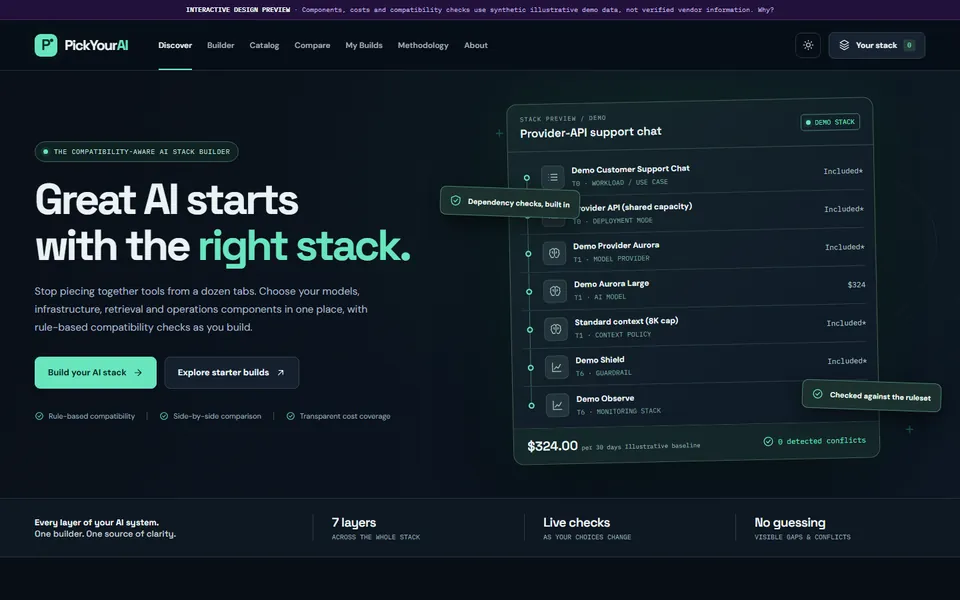
A PCPartPicker-style builder for complete AI systems: choose a workload and deployment mode, then models, infrastructure, data, tooling and deployment, with compatibility checked as you go.
React 19
TypeScript
Vite
JSON Schema
Problem, architecture & evidence
Problem
Planning an AI system means reconciling models, providers, hosting and licensing constraints that rarely appear in one place.
Architecture
Research contractVersioned contracts/v1 from the research repo
Contract-first compatibility evaluation from a vendored, versioned research contract.
Unknown information is never treated as compatible; results use explicit pass, fail, unknown and skipped states.
Static React SPA aimed at WCAG 2.2 AA.
Verification
CI requires format, lint, typecheck, contract verification, unit, end-to-end and visual-baseline tests before merge.
Status & limits. Engineering preview. Every component, price and compatibility result on the site today is synthetic demonstration data, labelled as such.
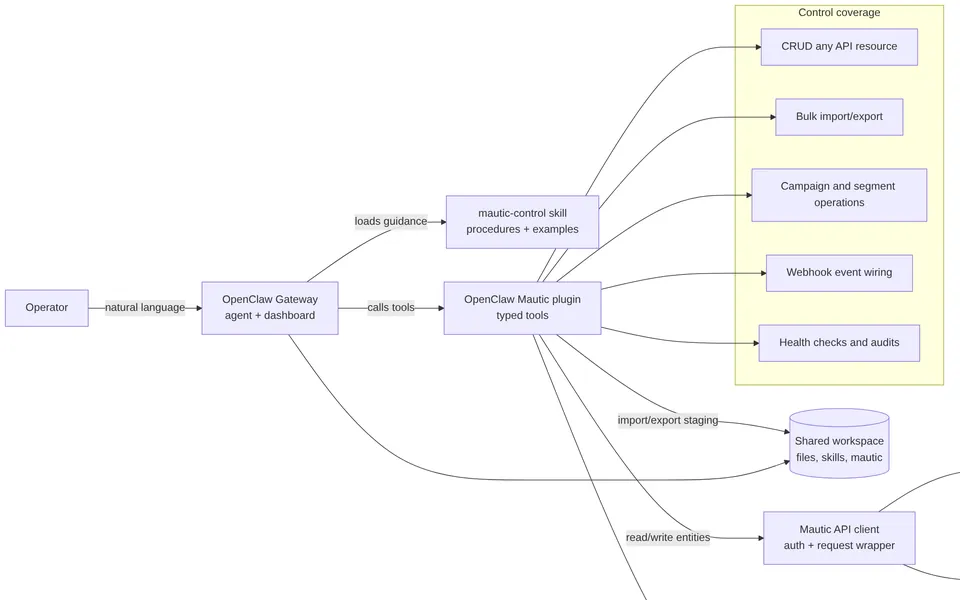
OpenClaw plugin that lets an AI agent operate a Mautic CRM through typed, policy-gated tools: API entities, webhook discovery, allowlisted console maintenance and guarded file staging.
JavaScript
OpenClaw
Mautic API
Webhooks
Problem, architecture & evidence
Problem
Giving an agent CRM access is useful only if that access is narrow, auditable and off by default.
Typed tools for status, API requests, entities, webhook triggers, console and workspace files.
Conservative defaults: maintenance, automation jobs and workspace read/write start disabled.
Credentials only from environment or secret store; refuses to send them to routable plain-HTTP hosts.
Private console bridge limited to allowlisted commands; filesystem bounded to one workspace root.
Verification
Verified against Mautic Community 7.1.1 with OpenClaw 2026.5.22+. CI lint, tests, package and readiness checks; published to ClawHub with OIDC trusted publishing.
Status & limits. Pre-1.0 (v0.1.14). Validate against your exact Mautic instance before broad rollout.
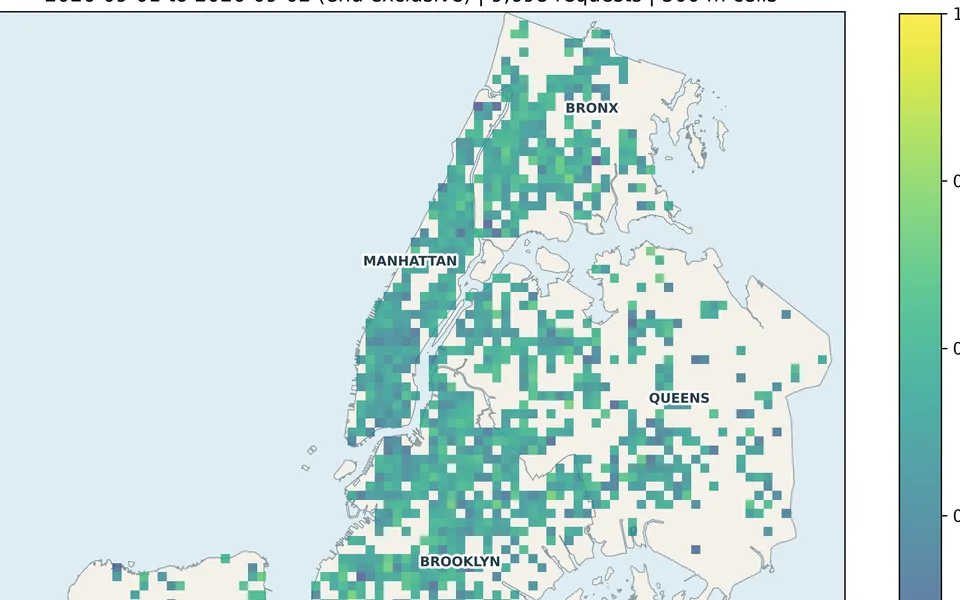
Downloads a bounded slice of NYC 311 service requests, evaluates complaint descriptions with typed JEV decisions, aggregates results on a 500-metre grid and renders interactive Folium maps and print-ready PNGs.
Python
NYC Open Data
JEV
Folium
SQLite
Problem, architecture & evidence
Problem
Raw 311 volume shows where people report problems, not how serious those reports might be. Typed model evaluation adds a second, inspectable signal.
Architecture
NYC 311 APIBounded date slice
Validate recordsDrop missing or invalid coordinates
DeduplicateOne evaluation per distinct description
JEV + cacheTyped answers, local SQLite cache
Grid aggregation500-metre projected cells
MapsInteractive HTML and PNG layers
Implemented
Public open-data ingestion with record validation and description de-duplication.
Typed model evaluation with response validation and a persistent local cache.
Projected grid aggregation for count, coverage, severity, concern and ambiguity layers.
Interactive HTML maps plus PNGs with borough shorelines.
Verification
Published run for 1 September 2026: 9,903 reports downloaded, 9,698 mapped across 2,043 cells, 634 API calls with no retries. 32 offline tests; run metadata records the query and input hash.
Status & limits. Research demonstration. Maps show model-estimated potential impact, not verified hazards or harm. Blank cells are not evidence of no problem.
Data: NYC Open Data and NYC Department of City Planning.
Cockpit extension that surfaces Intel Arc Pro B60 GPU telemetry from xpu-smi: a dedicated GPU page, GPU and GPU-memory rows in the Overview usage card, and a GPU card on the Metrics page.
JavaScript
systemd
Cockpit
xpu-smi
Linux
Problem, architecture & evidence
Problem
Cockpit shows CPU and memory out of the box but nothing for Intel discrete GPUs used for local AI workloads.
Architecture
xpu-smiIntel GPU telemetry source
systemd exporterRoot-owned poller (MEI access)
JSON in /runmetrics.json and minute history
Cockpit packageGPU page, Overview and Metrics cards
Cockpit Sensorslm-sensors temperatures and fans
Implemented
Root-owned systemd exporter polling xpu-smi into read-only JSON with minute history.
Cockpit package with GPU page, Overview and Metrics cards.
Integration with the upstream Cockpit Sensors package via lm-sensors.
Installer that backs up the Cockpit files it modifies, plus an uninstaller.
Verification
Running on the host it was written for: an Arc Pro B60 on an apt-based Linux system.
Status & limits. Validated scope is a single Intel Arc Pro B60 host. Other hardware and distributions are not covered.
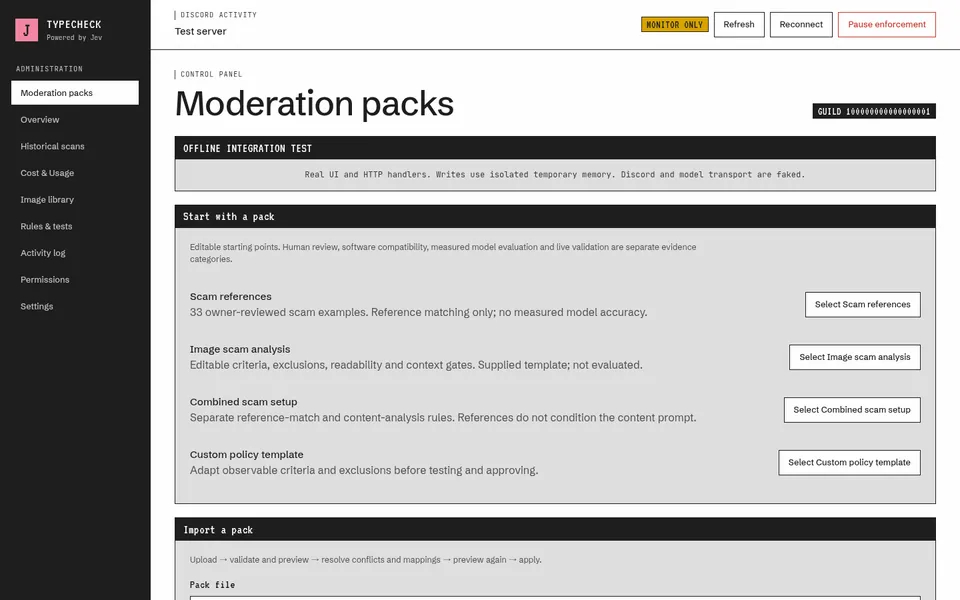
Discord text and image moderation bot with an embedded management Activity. Text rules, image-content rules and reference-image matching feed one deterministic policy engine that applies at most one user sanction per message.
TypeScript
Node.js
Discord
PostgreSQL
MySQL
Problem, architecture & evidence
Problem
Community moderators need automated help with scams and abuse without handing irreversible actions to an unreviewed model.
Architecture
Discord GatewayText and image creates and edits
Durable jobsStored in PostgreSQL or MySQL
Exact hash matchNormalised SHA-256 before any model call
Jev evaluationText, image content or reference rules
Policy engineDeterministic, one sanction per message
Action + ledgerREST action and audit record
Implemented
Gateway ingestion, durable jobs and REST actions from log-only to ban.
Exact normalised-hash matching before model comparison; per-action thresholds and second verification.
Administrator Activity: moderation packs, rules and tests, permissions, settings and credential rotation.
Cost and usage analytics with coverage warnings instead of invented totals.
Verification
155 unit/HTTP tests, PostgreSQL integration and 104 MySQL integration assertions, and an offline Compose recovery/restore drill passed.
Status & limits. Implementation candidate (v0.1.0). Real Discord acceptance, representative model accuracy, public TLS and independent security sign-off remain open. Text moderation and enforcement start disabled.
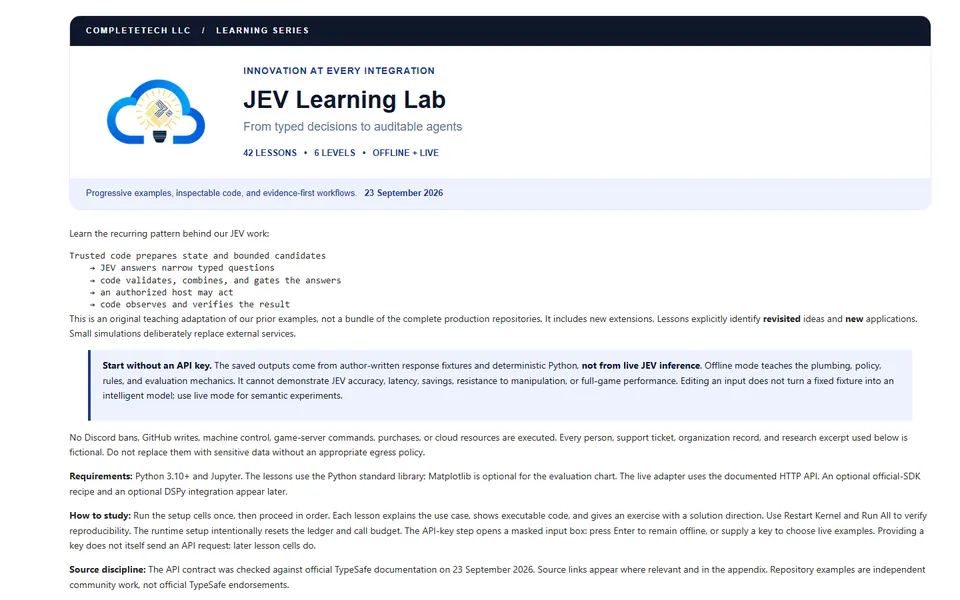
A self-contained Jupyter course on building auditable agents from typed decisions: 42 lessons, 50 executable code cells, 42 exercises with hints and an end-to-end incident-copilot capstone.
Python
Jupyter
JEV
Evaluation
Problem, architecture & evidence
Problem
Most agent tutorials blur where the model decides and where code enforces. This course keeps that boundary explicit in every lesson.
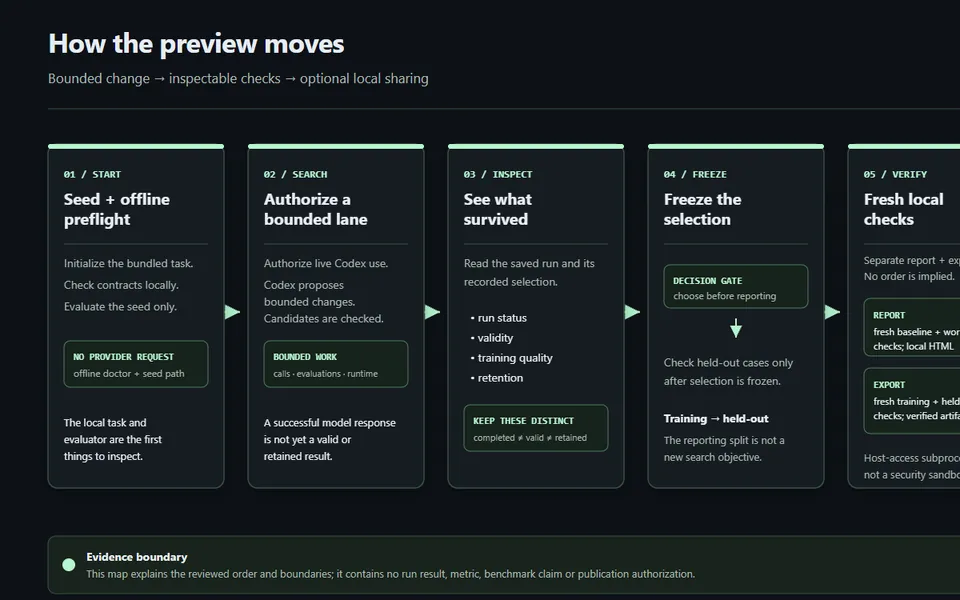
Open-source workbench for inspectable code-evolution experiments. Starts from a simple Python bin-packing heuristic, searches a bounded space of changes and saves every candidate and evaluation for review.
Python
LLM search
Evaluation
Reproducibility
Problem, architecture & evidence
Problem
AI-assisted optimisation claims are hard to trust when intermediate candidates and evaluations are summarised away.
Bounded searchCodex OAuth lane within local limits
Saved runEvery candidate, evaluation and call
Freeze selectionChoose before held-out reporting
Fresh export checkTraining and held-out cases re-run
Implemented
Bounded runs with local call, evaluation and runtime limits.
Every candidate workspace, evaluation, archive event and model call saved to a run directory.
Run status, validity, quality, retention and usage kept as separate dimensions.
Reports and exports re-run the chosen candidate in fresh subprocesses on training and held-out cases.
Verification
Offline task/evaluator preflight and focused offline tests; fresh export checks record candidate identity.
Status & limits. Engineering preview limited to bounded Python bin-packing. No improvement is guaranteed — “no improvement” is a valid result. Candidate execution is not a security sandbox.
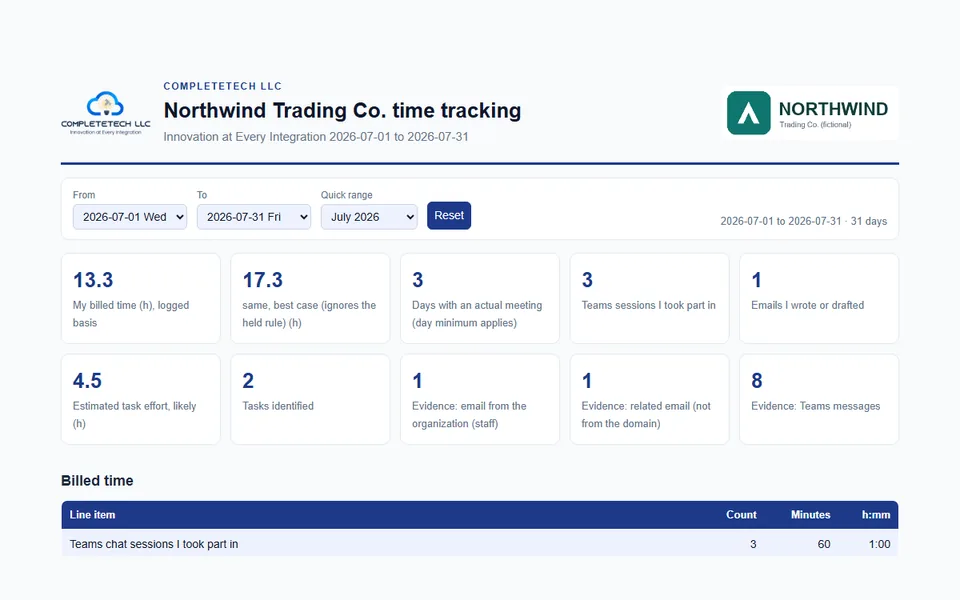
Agent skill that accounts for time spent with one organization from the operator’s own Outlook, Teams and calendar evidence, then produces an Excel workbook and a branded HTML report backed by a redacted evidence tree.
Python
openpyxl
JavaScript
Microsoft 365
Agent skill
Problem, architecture & evidence
Problem
Time spent with one client is scattered across mail, chats and meetings, so “how much time, on which days, and what is the evidence?” is hard to answer.
Architecture
Rules & consentBilling parameters set by the operator
EvidenceOutlook, Teams and calendar collectors
RedactionSecrets removed per day
Lapses & meetingsHeld meetings and activity lapses
WorkbookBilled time per day; recalculated and tied
Hours reportBranded HTML, light and dark
Implemented
Parameterised browser collectors for Outlook search results, Teams messages and calendar events, written to a redacted per-day evidence tree.
Billing rules as parameters: minimum per lapse, billing increment, meeting-day minimum and a held-meeting rule.
Excel workbook with formula totals, daily time, a month-grid calendar view and day detail tracing every minute to its source.
Single-file HTML report in light and dark themes with a heat calendar and date-range controls that recompute every figure.
Verification
Committed sample report, workbook and screenshot rendered from a fictional Northwind Trading Co. fixture; 16 package-contract tests in CI on Ubuntu, Windows and macOS, plus ruff and pyright checks.
Status & limits. Hours are estimates from evidence, not invoices; task effort is shown as low/high/likely estimates. Zero-result months may reflect search limits, meeting recaps and transcripts are not collected, and the workbook needs Excel or LibreOffice to recalculate.
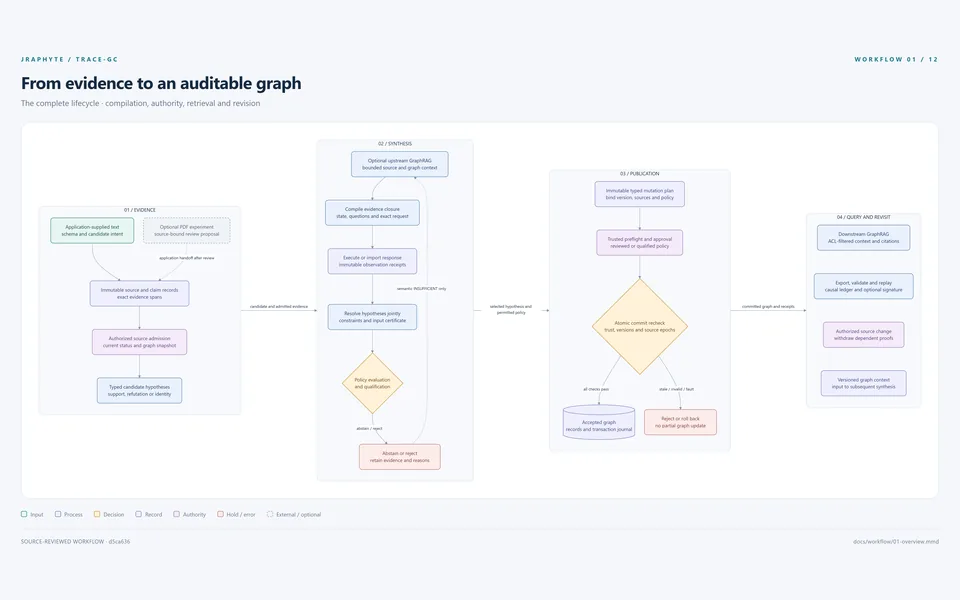
Python reference runtime that compiles source evidence into typed graph mutation plans, admits changes only through an approved transaction boundary, and feeds the resulting graph back into retrieval as source-cited GraphRAG context.
Python
SQLite
JSON Schema
Ed25519
Docling
Problem, architecture & evidence
Problem
Model-built knowledge graphs tend to lose track of which source justified which edge, and retrieval over them can quietly treat adjacency as proof.
Architecture
Source evidenceImmutable sources with exact spans
Mutation planTyped, hashed graph changes
ApprovalPolicy branch and scoped Ed25519 signature
Immutable source and claim records with exact evidence spans and per-field provenance.
Typed mutation plans with immutable hashes, policy branches, scoped Ed25519 approvals and atomic SQLite commits with rollback.
Upstream GraphRAG context for synthesis and a downstream query service returning ACL-filtered, source-cited contexts.
Experimental first-page PDF evidence validation comparing six extraction pipelines on 200 papers.
Verification
Validation report for 0.4.0: 1,402 tests run, 1,396 passed, 6 skipped, no live provider calls; CI on Python 3.11–3.13 plus Windows. On the 200-paper test, the best extractor reached 94.8% precision (91 of 96 proposals).
Status & limits. Reference implementation, not a production service. The 91-run benchmark uses synthetic fixtures and claims no real-model accuracy gain. Only SQLite and in-memory adapters are tested; Neo4j and pgvector are interface designs. PDF references await independent human review.
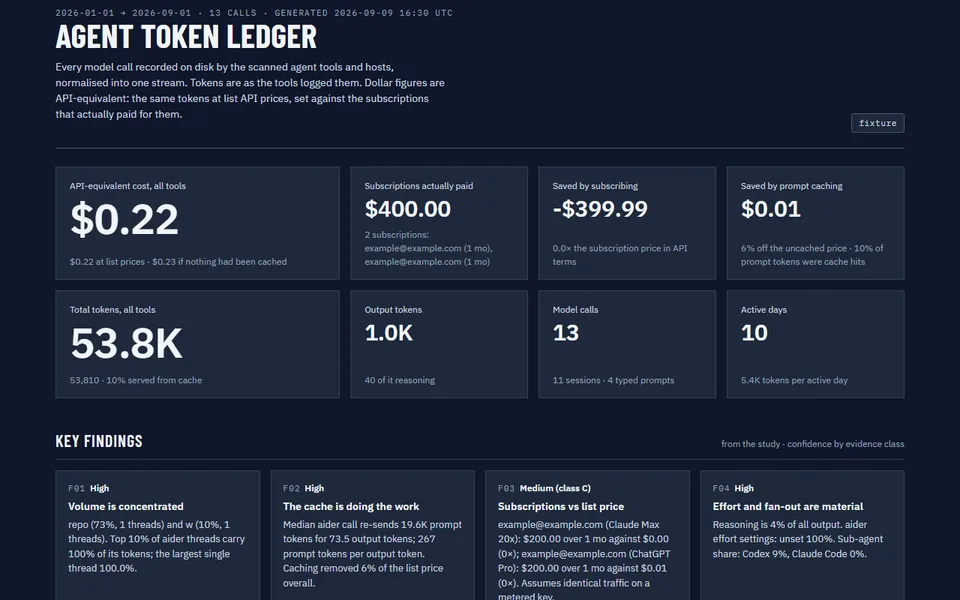
Agent skill that compiles every locally recorded AI coding-agent model call into one append-only, de-duplicated ledger, prices it at list API rates and splits it by subscription account.
Python
SQLite
HTML/CSS
Agent skill
Problem, architecture & evidence
Problem
Agent tools log tokens in incompatible formats, replay history into child threads and delete transcripts after weeks, so naive totals are wrong and nobody can say which account paid for what.
Parsers for Claude Code, Codex, Gemini CLI, Copilot CLI, aider, Cline and other tools, normalised into one event stream.
Append-only SQLite, JSON or CSV store keyed on stable event IDs, with replay and streamed-duplicate removal.
Rule-based account and billing-plan attribution with a confidence level per rule and an explicit unattributed row.
Light/dark dashboard, study package and ledger documents in Markdown, HTML, PDF and DOCX.
Verification
Synthetic fixtures for ten tools and five GitHub Actions workflows. Per-call records, tool counters and priced estimates are kept as separate evidence classes, and totals are checked against each tool’s own counters.
Status & limits. Dollar figures are API-equivalent estimates at list price, not invoices. Claude Code deletes transcripts after 30 days by default, so those totals are a lower bound; unpublished models are priced at a stated sibling and marked assumed.
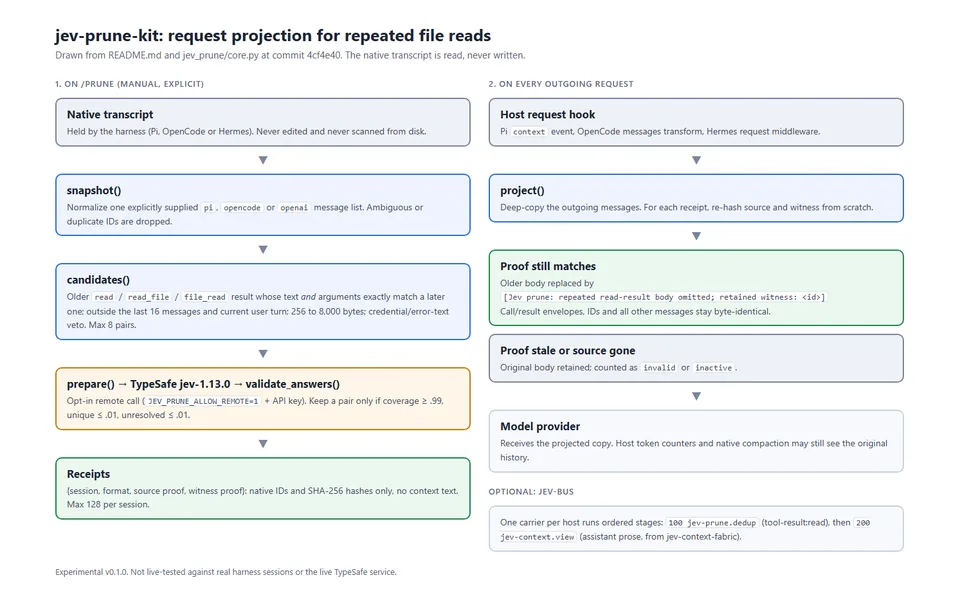
Experimental installer and assessment engine for coding agents. Exact repeated file-read results are left out of outgoing requests and replaced with a one-line marker naming the retained copy; the native transcript is never edited.
Python
Node.js
Agent harnesses
SHA-256
Problem, architecture & evidence
Problem
Long agent sessions re-read the same files, and every identical result body is sent again with each later request.
Architecture
SnapshotExplicit Pi, OpenCode or OpenAI message list
ProjectionMarker replaces the older body per request
Implemented
Request projection: only a copy of the outgoing messages changes; nothing is summarised or rewritten on disk.
Exact-repeat detection outside the last 16 messages and the current turn, with credential and error-text vetoes.
SHA-256 receipts re-verified on every request; a stale proof keeps the original body.
Experimental native adapters for Pi, OpenCode and Hermes, plus a coordination bus shared with JEV Context Fabric.
Verification
Repository suite of 107 Python and 15 Node tests. A fresh Windows run for the write-up passed all 15 Node tests and 100 of 107 Python tests; the six errors came from environment-dependent installer and config tests. No token-savings measurements exist.
Status & limits. Experimental v0.1.0, not tested against a live harness session or the live TypeSafe service. Pruning needs an opt-in remote assessment, and host token counters may still reflect the original history.
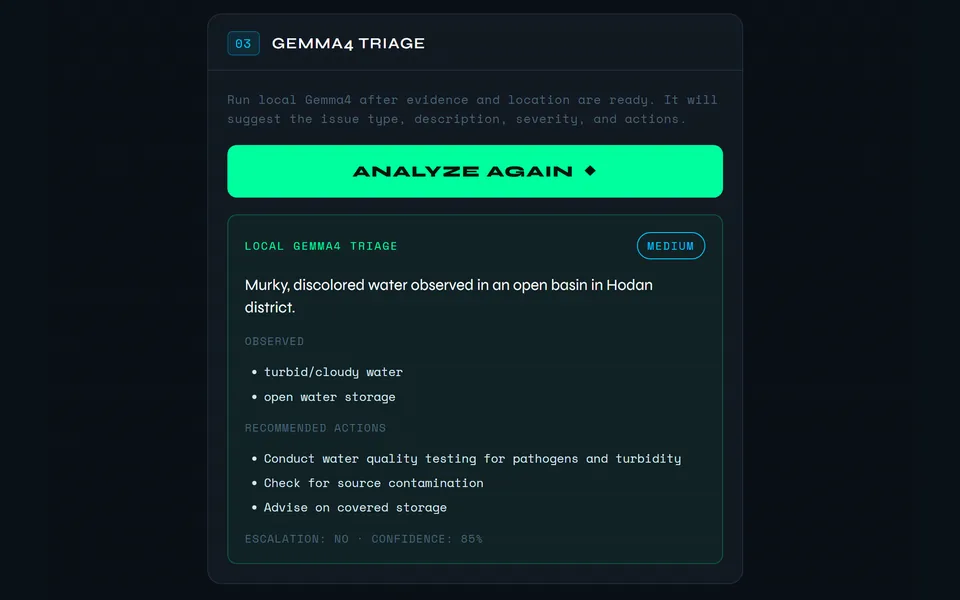
Built by Team Clean Drop for the Gemma 4 Good hackathon: a photo-first field-report workflow for water points in Somalia — capture, time and location, Gemma 4 triage and human review — shown in a demo video, interface screenshots and a Kaggle notebook.
Gemma 4
llama.cpp
Python
Jupyter / Kaggle
Problem, architecture & evidence
Problem
Water-point failures in low-connectivity areas go unreported or arrive without context responders can act on.
Architecture
CaptureField photo and note
Time & locationConfirmed timestamp and district
TriageSeverity, category and actions
Human reviewReporter edits the draft
ExportReviewed report as JSON and CSV
Implemented
Four-step report flow: capture image, confirm time and location, Gemma 4 triage, review the draft report.
Field Report API design that keeps the raw llama.cpp endpoint private and validates JSON output.
Kaggle notebook that exports reviewed reports as JSON and CSV.
Verification
Public demo video and interface screenshots. The notebook ran offline end to end for the write-up and produced its JSON, JSONL and CSV outputs.
Status & limits. Hackathon prototype; the entry missed the submission window. App and API source are not published. The notebook runs deterministic keyword triage, not Gemma 4 inference. The demo field image is AI-generated.
Team Clean Drop: frymatic, 1Soph, GalaxyRuler, GODFATHER and CompleteTech.
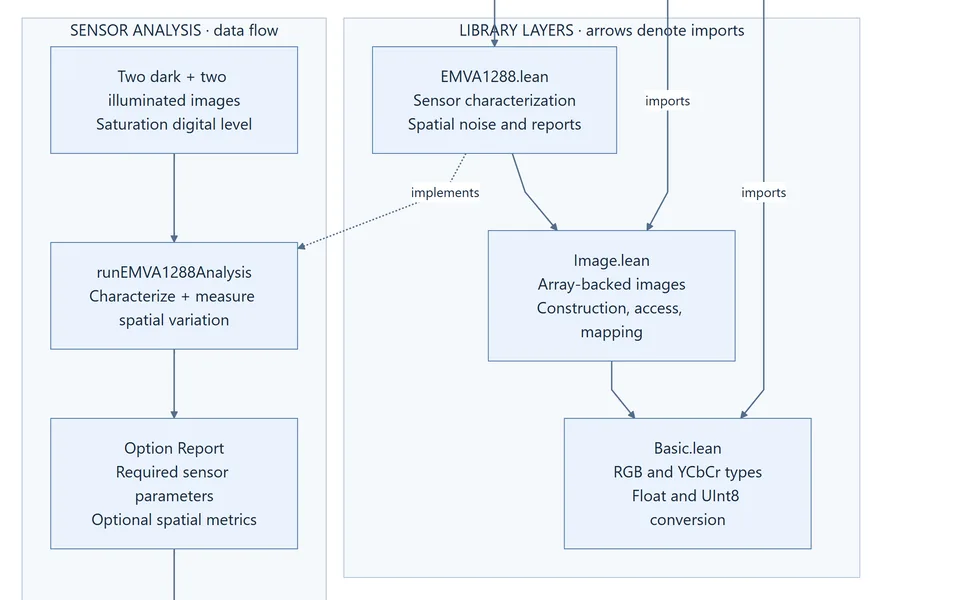
Architecture atlas contributed to a small Lean 4 library for RGB/YCbCr colour conversion and EMVA 1288-style sensor characterisation: an overview, twelve Mermaid views and light and dark renders, merged upstream.
Lean 4
Lake
Mermaid
Documentation
Problem, architecture & evidence
Problem
A first-project Lean 4 library had working definitions but no map of its types, calculations, failure paths or review limits.
Architecture
Upstream libraryLean 4 colour and sensor modules
Source readingTypes, functions and imports
ViewsOverview plus twelve Mermaid diagrams
Review viewUnchecked shapes and unguarded maths
MergeUpstream PR #1, archived release
Implemented
Overview plus twelve views covering every type and function, the calculations, failure paths and build/CI.
Light and dark PNG renders of each view with a reproducible render script.
A review view recording unchecked image shapes, unguarded division and log10, and demo-only values.
Contribution merged upstream as PR #1 and included in the archived release.
Verification
Merged upstream PR #1 (2026-09-23); Lean Action CI on the upstream repository; release archived on Zenodo as DOI 10.5281/zenodo.22908982, credited to the library author.
Status & limits. Documentation contribution only — the library is the upstream author’s work. The source has no formal proofs or assertion tests, and the atlas does not establish EMVA 1288 compliance.
Library by Kim Lien Vu (@vukimlien4706-cpu), Hanoi University of Science and Technology.
Interactive map of recorded crime in England on a 2 km grid, with a deliberately separate view of court-outcome demographics, built from Police.uk, MoJ and ONS open data.
Research demonstrationPython · Open data · Leaflet
Read-only, offline scanner that finds decision points in a codebase where a typed AI decision might help, then tests them with evidence before anything changes.
Browser-only prototype that parses USPTO PTO/SB/16 cover-sheet PDFs into structured JSON and a patent-matter lifecycle. The PDF never leaves the browser.
Local-first, source-backed memory layer for coding agents: canonical text with SHA-256 provenance, budgeted retrieval and an installer for eight agent harnesses.
Small Python agent that lets a language model run shell commands and answer questions from a command line, in direct, API or Ollama mode. Commands run without confirmation, so it is meant for disposable environments.
Python command-line tool for League of Legends streamers. Reads ranked data and recent matches from the Riot Games API, detects the active account in the local client and writes auto-updating HTML overlays for an OBS Browser Source.
Reinforcement-learning experiment on Atari Breakout: a PyTorch PPO agent with an IMPALA-style CNN and LSTM, plus a Random Network Distillation module for exploration, with manual-play examples and tests. Archived August 2025; no README or published results.
To provide the best experiences, we use technologies like cookies to store and/or access device information. Consenting to these technologies will allow us to process data such as browsing behavior or unique IDs on this site. Not consenting or withdrawing consent, may adversely affect certain features and functions.
Functional
Always active
The technical storage or access is strictly necessary for the legitimate purpose of enabling the use of a specific service explicitly requested by the subscriber or user, or for the sole purpose of carrying out the transmission of a communication over an electronic communications network.
Preferences
The technical storage or access is necessary for the legitimate purpose of storing preferences that are not requested by the subscriber or user.
Statistics
The technical storage or access that is used exclusively for statistical purposes.The technical storage or access that is used exclusively for anonymous statistical purposes. Without a subpoena, voluntary compliance on the part of your Internet Service Provider, or additional records from a third party, information stored or retrieved for this purpose alone cannot usually be used to identify you.
Marketing
The technical storage or access is required to create user profiles to send advertising, or to track the user on a website or across several websites for similar marketing purposes.